Choosing a personal-loan provider
Bank Loan vs Online Personal Loan in Canada
The best place to borrow is not determined by a branch or an app. Compare the provider behind the offer, the complete borrowing cost, the repayment fit and the protections that apply.
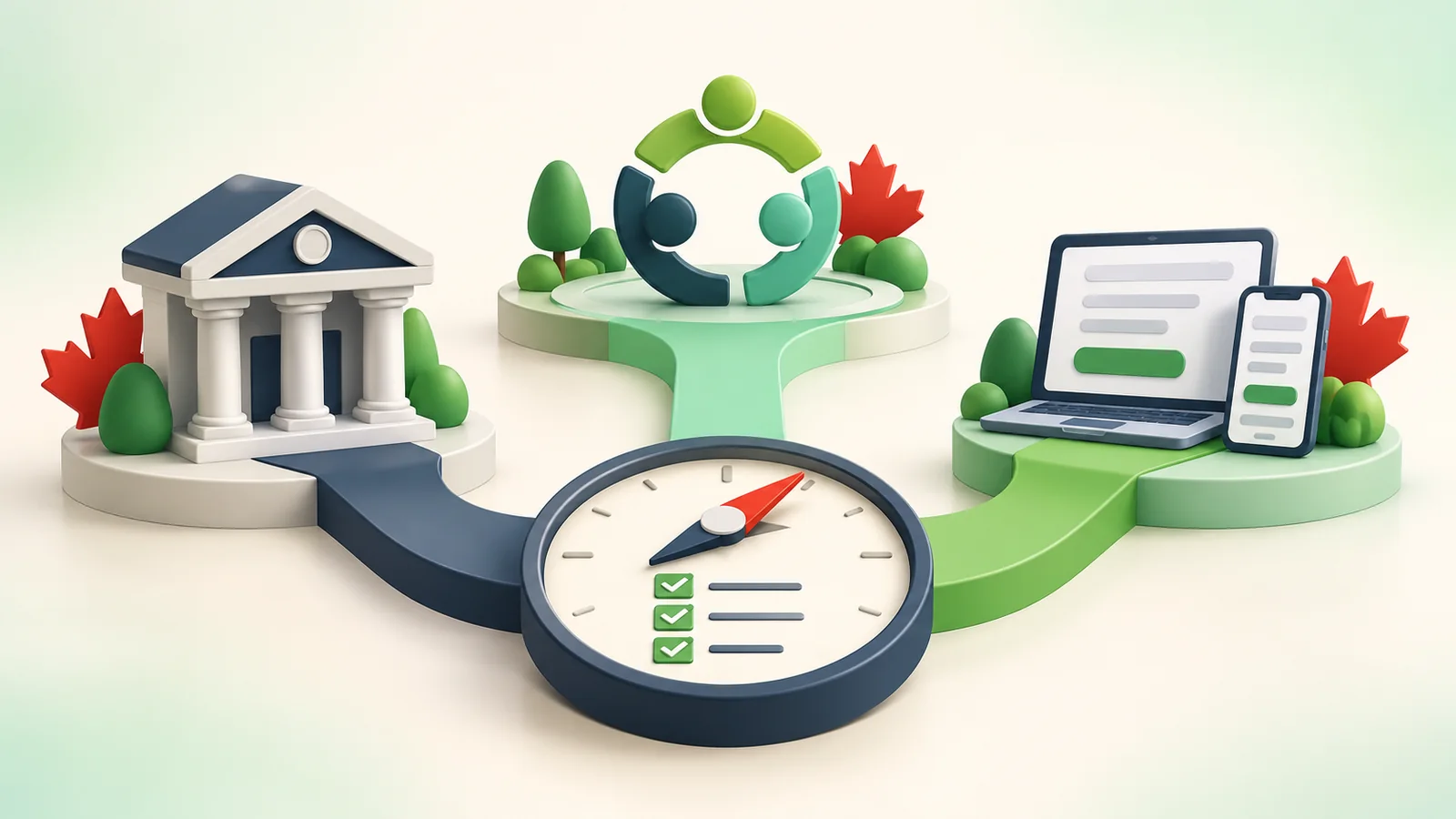
The first distinction: lender type versus application channel
A bank loan describes who provides the credit. An online personal loan describes how the borrower finds, requests or manages it. A Canadian bank may complete the entire process online. A credit union may combine an online application with branch service. A non-bank lender may operate only through a website or app.
That overlap matters because a polished digital experience does not reveal the rate, the regulator or the complaint process. Start by identifying the legal name of the lender that would issue the agreement. Then compare the offer itself. Do not treat “online” as automatically faster, easier, more expensive or less secure.
Lendari is a comparison and referral platform, not a lender. Completing the comparison form is not a loan agreement and does not guarantee approval, a rate, an amount or funding time. Any offer and credit decision come from an independent provider.
Bank, credit union and online lender: practical differences
Banks
All Canadian banks are federally regulated financial institutions. They often offer broad product ranges, established online banking and branch support. An existing customer may find it convenient to manage a loan beside a chequing account, but a banking relationship does not guarantee approval or the lowest cost.
For personal loans from federally regulated institutions, disclosure and conduct rules apply. The Financial Consumer Agency of Canada says the borrower should receive information such as the principal, interest rate, term, payment amount, fees and optional services. The institution must also have a complaint-handling process.
Credit unions
Credit unions may emphasize local service and member relationships. Many are regulated provincially or territorially, while federal credit unions fall under federal oversight. Membership rules, geographic availability and digital features vary. Ask which regulator applies and whether membership is required before the loan can be issued.
Other online lenders
Non-bank lenders can provide a streamlined digital process and may evaluate applications differently. The important questions are whether the provider is legally operating in the borrower’s province, what rules govern the product, and whether the agreement clearly identifies every cost. “Fintech” is a delivery model, not a consumer-protection category.
Compare the same amount over the same period
A useful comparison needs a common baseline. Put the same requested amount and similar repayment term beside each other. A lower payment can result from a longer term and may produce a higher total repayment.
- Amount received: confirm whether any fee is deducted before funds are delivered.
- Annual rate and cost of borrowing: use the disclosure provided rather than an advertised “from” rate.
- Payment schedule: compare amount, frequency, first due date and number of payments.
- Fees and optional products: identify administration charges and loan insurance that is not required.
- Early repayment: ask whether extra payments or full payoff carry a charge.
- Late or returned payments: understand charges, collection steps and possible credit reporting.
- Total repayment: multiply each payment by the number of payments, then reconcile that result with the disclosure.
Our guide to personal-loan rates and total borrowing cost explains why rate alone is not enough.
Eligibility may differ, but no channel guarantees approval
FCAC notes that lenders generally ask for regular income, a bank account and a permanent address, and that most conduct a credit check. Providers may also evaluate existing debts, payment history, employment stability and the requested amount. The relative weight of those factors can differ.
A bank may use information from an existing relationship, but it must still assess the request. An online lender may automate parts of the review, but automation does not remove eligibility requirements. A quick response is not the same as funding, and pre-qualification is not necessarily a final approval.
Borrow only what the budget can support. Use our guide on choosing a personal-loan amount to estimate room for a payment before comparing providers.
Will the application affect your credit?
Viewing educational pages and public rates does not open a credit account. A lender may request consent to access a credit report later. Ask whether the check is a hard or soft inquiry and when it occurs. A hard inquiry can affect the credit score; a soft inquiry does not.
Do not send several complete applications merely to see what happens. First narrow the field using public costs, eligibility information and provider credentials. Then review the consent language before moving from comparison to a full application. Learn more in our guide to personal loans and credit scores.
Regulation and complaint routes
Regulation depends on the institution and sometimes the province. Banks and federal credit unions are federally regulated. Many credit unions and non-bank lending companies fall under provincial or territorial rules. Consumer protections and the authority handling a complaint can therefore differ.
Before accepting, record the provider’s legal name, physical or mailing address, customer-service channel and applicable regulator. Check the regulator’s public information rather than relying on a badge displayed by the lender. If a problem occurs, complain to the lender in writing and follow the escalation path for that institution.
Security checks for an online loan
A secure-looking website alone is not proof of legitimacy. Confirm the domain spelling and use contact information you found independently. Read the privacy notice to understand what data is collected, who receives it and how consent can be withdrawn where applicable.
- Do not send online-banking passwords, PINs or one-time security codes.
- Be cautious when a supposed lender pressures you to act immediately.
- Do not pay a fee by gift card, cryptocurrency or transfer simply to “release” a promised loan.
- Keep copies of the application, consent, disclosure and agreement.
- Confirm that pre-authorized debit details match the payment schedule.
For a broader digital checklist, see how to compare online personal loans safely.
Which option may fit which borrower?
A bank may suit someone who values branch access, an established relationship and a familiar digital platform. A credit union may suit a borrower who prefers member service or local access. A digital non-bank provider may suit someone who values an online workflow or wants to compare a different underwriting approach.
Those are starting points, not predictions. The best fit is the offer that is legitimate, affordable and understandable after the borrower compares the complete agreement. A familiar logo does not make an unaffordable payment safe, and a fast interface does not make a costly loan good value.
A seven-step comparison checklist
- Define the amount needed and the highest payment the budget can safely absorb.
- Identify the legal lender behind every option.
- Confirm the applicable regulator and complaint path.
- Compare the same amount and a similar term.
- Review rate, all fees, payment dates and total repayment.
- Read the credit-check, privacy and pre-authorized-debit consent.
- Accept only after receiving and understanding the complete agreement.
If none of the offers fits the budget, stopping is a valid decision. A comparison does not create an obligation to borrow.
Frequently asked questions
Is an online personal loan different from a bank loan?
Online describes the application or service channel, not necessarily the lender type. Banks, credit unions and other providers may all lend online. Compare the legal provider, cost and agreement.
Are bank personal loans always cheaper?
No. Rates, fees and terms depend on the provider, product and applicant. Compare the total repayment for the same amount and period.
Are online personal loans safe in Canada?
A legitimate digital process can be safe, but verify the lender, regulator or licence where applicable, Canadian contact details, privacy terms and website. Never pay an unusual upfront fee just to unlock a promised loan.
Does comparing bank and online loans affect my credit score?
Reading public information does not. A provider may request a credit check during an application, and a hard inquiry may affect the score. Confirm the type and timing first.
Official Canadian resources
Review FCAC’s guidance on personal loans and comparing costs, choosing a financial institution and understanding regulation, and personal-loan disclosure rights at federally regulated institutions.
Compare personal-loan options
Start with the amount you need. If options are available, verify the independent provider and compare the rate, fees, term and total repayment before deciding.
Compare personal-loan options ↗