Repayment length and total cost
Personal Loan Terms in Canada: How Length Changes Payments and Cost
A loan term is more than a date on the agreement. It shapes the payment schedule, how long the debt remains, and often the total amount repaid. Compare the full structure—not only the smallest monthly payment.
What does “personal loan term” mean?
The term is the period during which your loan agreement is in effect. It is usually stated in months or years. The Financial Consumer Agency of Canada (FCAC) says most personal loans range from 6 to 60 months, although an actual provider may offer a narrower or different range.
The term works with the amount borrowed, interest rate, fees and payment frequency. Together, these inputs determine the scheduled payment and total repayment. A quote with a low payment is not automatically the least expensive choice.
Lendari is a comparison and referral platform, not a lender. Completing a comparison form is not a credit agreement and does not guarantee approval, a rate, an amount, a term or funding time. Any available provider independently sets and verifies its offer.
Shorter term versus longer term
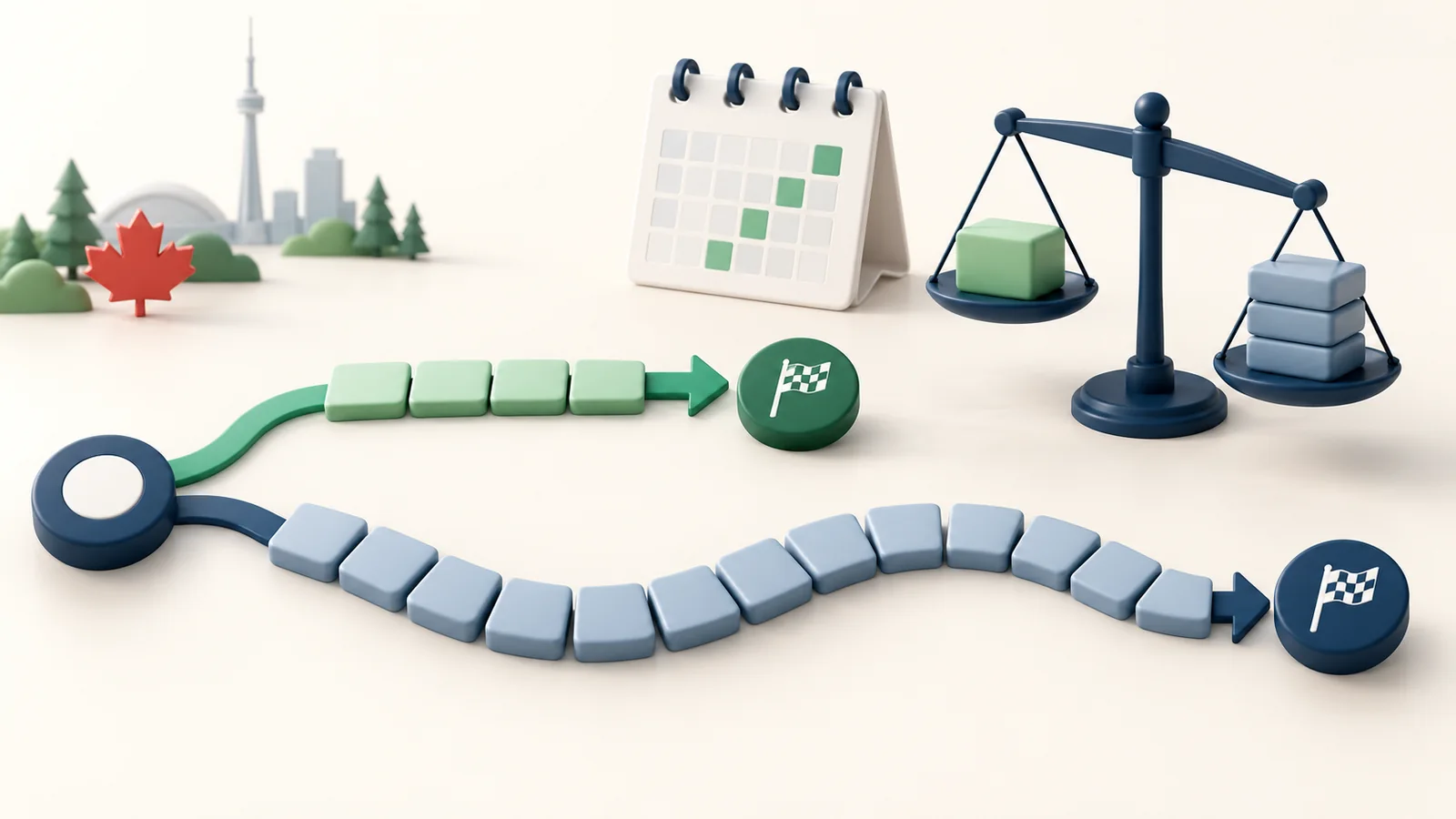
When the amount and rate are otherwise the same, a shorter term generally means fewer, larger payments. Because the balance is outstanding for less time, the total interest is usually lower. A longer term spreads repayment over more instalments, which may lower each payment but usually increases the total interest paid.
FCAC illustrates this trade-off with a $2,000 loan at 19.99%: its example shows total repayment rising as the term extends from 12 to 36 to 60 months. The figures are illustrative, not a market quote, but the principle matters—payment size and total cost can move in opposite directions.
When a shorter term may fit
- The higher payment fits comfortably after essential expenses.
- You want to reduce the time the balance is outstanding.
- The written comparison shows meaningfully lower total interest and fees.
- You can keep an emergency buffer rather than using every available dollar.
When a longer term may be considered
- A shorter schedule would make the payment unstable or unaffordable.
- You need more room for variable expenses and savings.
- The agreement allows useful extra payments without costly restrictions.
- You understand the additional total cost and accept it deliberately.
The right term is not simply the shortest available. It is the shortest schedule whose required payment remains realistic through an ordinary difficult month.
Calculate total repayment, not only the payment
A practical first check is to multiply the scheduled payment by the number of payments, then add any charges that are not already included. Compare that total with the principal. The difference is an estimate of the borrowing cost, subject to the agreement’s calculation method and variable-rate changes.
Also compare the annual percentage rate (APR) when it is disclosed. APR can include applicable borrowing charges and may differ from the stated interest rate. Review our guide to personal-loan rates and total cost for the distinction.
Do not assume two 36-month offers cost the same. Different rates, origination or administrative charges, optional insurance and payment timing can produce different totals.
Payment frequency matters
Payments may be weekly, biweekly, semi-monthly or monthly. Frequency changes the number of withdrawals and how they line up with income. Convert offers to the same time period before comparing them. A biweekly amount cannot be compared directly with a monthly amount by simply doubling it, because there are generally 26 biweekly periods in a year.
Check the exact due dates, first payment date and treatment of weekends or holidays. Leave enough money in the account before each withdrawal. An insufficient-funds event may trigger charges from both the financial institution and the lender and can lead to a missed-payment record.
Term and amortization are related, but not always identical
The amortization period is the time required to repay the loan in full under the current schedule. For many straightforward instalment loans, it matches the term. If it differs, a balance may remain when the term ends, and the borrower may need to renew, refinance or make a final payment.
FCAC says federally regulated institutions must disclose the term and, when different, the amortization period for a personal loan. Ask what happens at the end of the term and whether a balloon or residual amount remains. Do not rely on the payment alone to infer that the balance reaches zero.
Open, closed and early-repayment rules
An open loan generally provides more freedom to repay principal early, while a closed loan may limit extra payments or apply a prepayment charge. Labels and specific rights depend on the agreement, so read the actual clause rather than relying on the product name.
FCAC notes that some lenders allow extra payments or full repayment before the end of the term without penalty, while others may charge a fee. Ask:
- Can I make lump-sum or additional payments?
- Is there a maximum extra amount or limited payment date?
- Does an extra payment reduce principal immediately?
- Will the payment amount fall, or will the payoff date move earlier?
- Is there a prepayment charge, discharge fee or administration fee?
Flexible prepayment can make a longer term less restrictive, but it does not justify accepting a payment you cannot manage. Future extra payments are optional plans, not guaranteed savings.
Fixed and variable rates across the term
A fixed rate is set according to the agreement. A variable rate can change based on the stated reference or method. With a variable loan, a rate change may alter the payment, the split between interest and principal, the payoff date or some combination of these.
Ask for a plain-language explanation of what changes when the rate changes. Stress-test the budget at a higher rate instead of assuming today’s payment lasts for the whole term. The personal loan versus line of credit guide also explains fixed instalment and revolving structures.
How to compare personal loan terms side by side
- Use the same requested amount. A larger loan can make a payment comparison misleading.
- Record the annual rate and APR. Note whether the rate is fixed or variable.
- List every mandatory fee. Separate optional products such as insurance.
- Normalize payment frequency. Compare yearly and full-term outflows.
- Count all payments. Confirm the balance will be zero at the end.
- Check prepayment rights. Price any penalty or administration charge.
- Test affordability. Include housing, food, transport, utilities, existing debts and savings.
- Read default consequences. Know late fees, collection steps and any collateral risk.
If the available amount itself is uncertain, start with our guide on choosing a personal-loan amount. Borrow only what is needed, even if more is offered.
Questions to ask before accepting
- What is the exact term in months and the number of payments?
- What is the total amount of all payments if the schedule is followed?
- Does the term equal the amortization period?
- Is there any amount due at the end?
- Is the loan open or closed, and what does that mean here?
- Can the rate or payment change?
- Which fees are mandatory and which services are optional?
- Can I cancel optional loan insurance separately?
- What happens if a payment is late or returned?
Keep the disclosure statement and agreement. For a federally regulated institution, FCAC explains that specified information must appear in the disclosure, including payment amount and frequency, term, rate, APR where applicable, and other charges.
Frequently asked questions
What is a personal loan term?
It is the period during which the loan agreement is in effect. It influences the number and size of payments and should be reviewed with rates, fees and total repayment.
Is a longer personal loan term cheaper?
Not usually in total. It may lower each scheduled payment but often increases total interest because the balance is repaid over a longer period.
Can you pay a personal loan off early in Canada?
It depends on the agreement. Some lenders allow it without a penalty; others may restrict extra payments or charge a fee.
Are term and amortization the same?
They can be, but not always. If amortization is longer, a balance may remain at the end of the term.
Official Canadian resources
Review FCAC’s guidance on personal loans, terms and total cost and personal-loan disclosure rights.
Compare the whole repayment path
Use the amount you need, then compare payment size, total repayment, term and flexibility. Review any provider’s written agreement before deciding.
Compare personal-loan options ↗